Today's paradigm of rapidly advancing technology is not only accelerating, but converging, self-reinforcing and merging. Metabolic Engineering is an excellent example of information technology, biotechnology, materials science and nanotechnology being blended to achieve an end result that none on an individual basis would likely achieve. We have been creating hybrid crops with desireable characteristics for many decades (if not centuries), but the difference here is that the intervention is much more direct, the end result more pre-defined and the organisms used go well beyond crops and different breeds of livestock. While there are certainly risks, and there will likely a multitude of unforeseen and undesireable results, we are entering an age where "hit & miss" will be increasing replaced with "aim & fire". Please see the following link for more background on metabolic engineering:
The Future of Metabolic Engineering – Designer Molecules, Cells and Microorganisms « Berkeley Lab News Center
Friday, December 3, 2010

From Citigroup, a New Volatility-Linked ETN
The below article is promising in that the available VIX-related shares are issued as "ETNs" and are therefore subject to the creditworthiness of the issuer (unlike ETFs), but the article indicates that there are more issuers coming to market and, as a result, some of the credit risk can be mitigated via usage of more than one VIX sensitive ETN within a portfolio. The Citigroup offering is particularly interesting, but I think we need to see some trading history to get a better feel for how this hybrid structure should be used.
From Citigroup, a New Volatility-Linked ETN
From Citigroup, a New Volatility-Linked ETN
Good News & (less obvious) Better News
Good News:
• DECEMBER 2, 2010, 10:42 A.M. ET
US Stocks Rise On Pending Home Sales, Hope In Europe
By Steven Russolillo
Of DOW JONES NEWSWIRES
“NEW YORK (Dow Jones)--U.S. stocks extended gains Thursday after pending home sales unexpectedly soared and investors mulled whether European officials can help stop the spread of the euro zone's debt crisis.”
The combination of the two issues mentioned above will be supportive of the US Dollar should they continue their recently established trends.
What I always find interesting is how things evolve in front of everyone’s eyes yet their perceptions are so slow to respond. Occasionally, I like to offer those who I communicate with an opportunity to win a friendly bet with their favorite “victim”. Ask your “target” the following question:
“How much has the S&P Homebuilders ETF underperformed the Emerging Market Index ETF over the past 3 years in terms of price?”
a) The Homebuilders ETF has underperformed the Emerging Market Index ETF between 15-24%
b) The Homebuilders ETF has underperformed the Emerging Market Index ETF by over 25-34%
c) The Homebuilders ETF has underperformed the Emerging Market Index ETF by over 35%
d) None of the above
The answer: None of the above
Below is a 3-year chart showing how the S&P Homebuilder ETF is effectively tied with the Emerging Market Index despite the “Rapid Rise of China” and the “Worst Real Estate Crisis Since the Great Depression!”:
• DECEMBER 2, 2010, 10:42 A.M. ET
US Stocks Rise On Pending Home Sales, Hope In Europe
By Steven Russolillo
Of DOW JONES NEWSWIRES
“NEW YORK (Dow Jones)--U.S. stocks extended gains Thursday after pending home sales unexpectedly soared and investors mulled whether European officials can help stop the spread of the euro zone's debt crisis.”
The combination of the two issues mentioned above will be supportive of the US Dollar should they continue their recently established trends.
What I always find interesting is how things evolve in front of everyone’s eyes yet their perceptions are so slow to respond. Occasionally, I like to offer those who I communicate with an opportunity to win a friendly bet with their favorite “victim”. Ask your “target” the following question:
“How much has the S&P Homebuilders ETF underperformed the Emerging Market Index ETF over the past 3 years in terms of price?”
a) The Homebuilders ETF has underperformed the Emerging Market Index ETF between 15-24%
b) The Homebuilders ETF has underperformed the Emerging Market Index ETF by over 25-34%
c) The Homebuilders ETF has underperformed the Emerging Market Index ETF by over 35%
d) None of the above
The answer: None of the above
Below is a 3-year chart showing how the S&P Homebuilder ETF is effectively tied with the Emerging Market Index despite the “Rapid Rise of China” and the “Worst Real Estate Crisis Since the Great Depression!”:

(less obvious) Better News:
"Breakthrough Chip Technology Lights the Path to Exascale Computing"
December 2, 2010 by Editor
IBM CMOS Integrated Nanophotonics (IBM)
IBM scientists Wednesday unveiled a new chip technology that integrates electrical and optical devices on the same piece of silicon, enabling computer chips to communicate using pulses of light (instead of electrical signals), resulting in smaller, faster and more power-efficient chips than is possible with conventional technologies.
The new technology, called CMOS Integrated Silicon Nanophotonics, is the result of a decade of development at IBM’s global Research laboratories.
The patented technology will change and improve the way computer chips communicate — by integrating optical devices and functions directly onto a silicon chip, enabling over 10X improvement in integration density than is feasible with current manufacturing techniques."
http://www.kurzweilai.net/breakthrough-chip-technology-lights-the-path-to-exascale-computing?utm_source=KurzweilAI+Daily+Newsletter&utm_campaign=cd1c882696-UA-946742-1&utm_medium=email
Now you have probably never heard of “nanophotonics”, and if you haven’t , don’t feel bad. It isn’t exactly holiday season cocktail chatter.
The reason why this breakthrough is important is that the technology, and those similar to it, will enable the continuation of the rapid advancement in the computing power which in turn is vital to advances in many areas, but especially in the area of life sciences (i.e. healthcare).
The greatest promise for curing the many diseases we are faced with comes in the form of enhanced molecular diagnostics, molecular synthesis and genetic information processing. These are all fantastically computationally demanding activities, but the bulk of healthcare costs come from the treatment of chronic diseases rather than actual cures. The breakthroughs in genetic sequencing, RNAi (a means to suppress undesirable genetic expression), and molecular analysis via digital means during the past decade are all just first steps in overcoming the healthcare & quality of life challenges we will face as we age.
This development is not only good for the “N” (nanotechnology), the “B” (biotechnology) and the “I” (information) in my phrase “N.ew B.R.I.C.”, but also the “R” (robotics) and “C” (cognitive). As we improve our computer technology by the next 10-100 fold, we will start to approach the needed levels to achieve broader forms of artificial intelligence that will in turn propel both robotics and cognitive technologies to the next level. As we age as a species, we will not only have increased health issues, but also we will need assistance from robotics to overcome physical impairments, as well as cognitive innovation to treat/manage dementia related challenges.
Most should not invest in “science projects”, and no, I am not recommending IBM as an investment, but it is important to remember our problems will not be truly resolved by easy money, government intervention or political debate. Our future is bright because of the same essential ingredient that Edison used to create the light bulb: curiosity, vision & innovation.
So hopefully, as people take advantage of the house bargains that are available today they will have the option of living in that home for many years to come with little medical assistance and perhaps a very loyal “robo-dog” that not only doesn’t need to be walked, but can also prepare their tax return!
Saturday, November 27, 2010
How Wealthy is America?
"How wealthy is the USA?" This is a critical question as it lies at the heart of so many other issues:
"Can the US service its debt?"
"Can we afford health care for the Boomers?"
"What backs the US Dollar?"
"Is the US becoming a "banana republic"?"
"Should the US Dollar remain the world's reserve currency?"
"Will the US remain an economic superpower?"
You could answer all of these questions in countless ways, but here is at least one quick perspective that may help those who are riddled with concern about the future of America:
Per the most recent date from the Federal Reserve, U.S. Household Net Worth (assets less all mortgage, credit card or other debt) totals over $53 trillion.
http://www.federalreserve.gov/releases/z1/current/z1r-1.pdf
Interestingly, per the World Federation of Exchanges, the total market capitalization of global equities is $52.7 trillion.
http://www.world-exchanges.org/statistics/key-market-figures
So, the people of the U.S. collectively, theoretically, have sufficient wealth to buy all the publicly traded stocks in the world!
Further, foreign currency reserves of China total under $3 trillion. U.S. households possess over $7 trillion in deposits.
http://www.safe.gov.cn/model_safe_en/tjsj_en/tjsj_detail_en.jsp?ID=30303000000000000,19&id=4
When was the last time you heard someone say: "the citizens (not the government) of the US have more economic power than China." ?
"Can the US service its debt?"
"Can we afford health care for the Boomers?"
"What backs the US Dollar?"
"Is the US becoming a "banana republic"?"
"Should the US Dollar remain the world's reserve currency?"
"Will the US remain an economic superpower?"
You could answer all of these questions in countless ways, but here is at least one quick perspective that may help those who are riddled with concern about the future of America:
Per the most recent date from the Federal Reserve, U.S. Household Net Worth (assets less all mortgage, credit card or other debt) totals over $53 trillion.
http://www.federalreserve.gov/releases/z1/current/z1r-1.pdf
Interestingly, per the World Federation of Exchanges, the total market capitalization of global equities is $52.7 trillion.
http://www.world-exchanges.org/statistics/key-market-figures
So, the people of the U.S. collectively, theoretically, have sufficient wealth to buy all the publicly traded stocks in the world!
Further, foreign currency reserves of China total under $3 trillion. U.S. households possess over $7 trillion in deposits.
http://www.safe.gov.cn/model_safe_en/tjsj_en/tjsj_detail_en.jsp?ID=30303000000000000,19&id=4
When was the last time you heard someone say: "the citizens (not the government) of the US have more economic power than China." ?
Friday, November 26, 2010
10 Questions for Ray Kurzweil
At the below link, Kurzweil answers a number of the key questions asked by those unfamiliar with the Singularity literature in a very brief form:
10 Questions for Ray Kurzweil
10 Questions for Ray Kurzweil
Wednesday, November 24, 2010
There’s Nothing ‘Rapacious’ About America’s Income Differences
Once again Mark Perry slays the "rhetorical dragon" with some simple, but well presented data:
There’s Nothing ‘Rapacious’ About America’s Income Differences
There’s Nothing ‘Rapacious’ About America’s Income Differences
Friday, November 19, 2010
Growth in China is Self-Defeating; Growth in Innovation is Self-Reinforcing
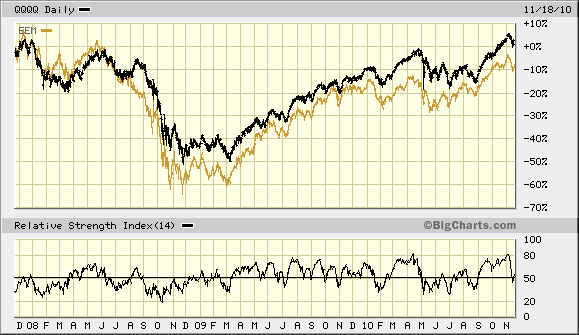
The perception that growth can only be found in the emerging markets is slowly eroding. China is increasingly faced with high inflation, infra-structure challenges, a weak consumer segment, political pressures, environmental threats, unfavorable demographics and it is bidding against itself in the commodity markets. Technology/innovation ( nanotechnology, life sciences and information technology in particular ), on the other hand, is accelerating, converging and reinforcing itself. The below chart shows that the NASDAQ 100 (a proxy for innovation) has outperformed the Emerging Market Index (very sensitive to economic activity in China) over the past 3 years and I believe this will continue for several years to come:
The above is not a recommendation of any particular security or investment strategy. It is simply a statement of personal opinion.
Explore Nanotechnology !
http://www.nanularity.com/
Subscribe to:
Comments (Atom)